Roseville has grown into one of the Sacramento region’s busiest suburbs, with an expanding health care workforce and plenty of residents balancing shift work, school, and family life. For many of them, fitting a full training day into the calendar is the hard part — which is where American Heart Association (AHA) Self-Guided Learning comes in. The format separates a certification course into an online knowledge portion you complete at your own pace and a hands-on skills portion done in person, so you’re not tied to a single fixed class time. Below, you’ll find how Self-Guided Learning applies to BLS, ACLS, PALS, CPR, AED, and First Aid, who each course is for, and how someone in Roseville, California can identify the right one before spending time or money on the wrong class.
Key takeaway: AHA Self-Guided Learning lets you work through the coursework independently, then complete the in-person skills check that provider certifications call for. The course you need is decided by your role and the requirements of your employer, school, or licensing body — so verify that first, then pick the format that fits your week.
What AHA Self-Guided Learning Is and How It Works
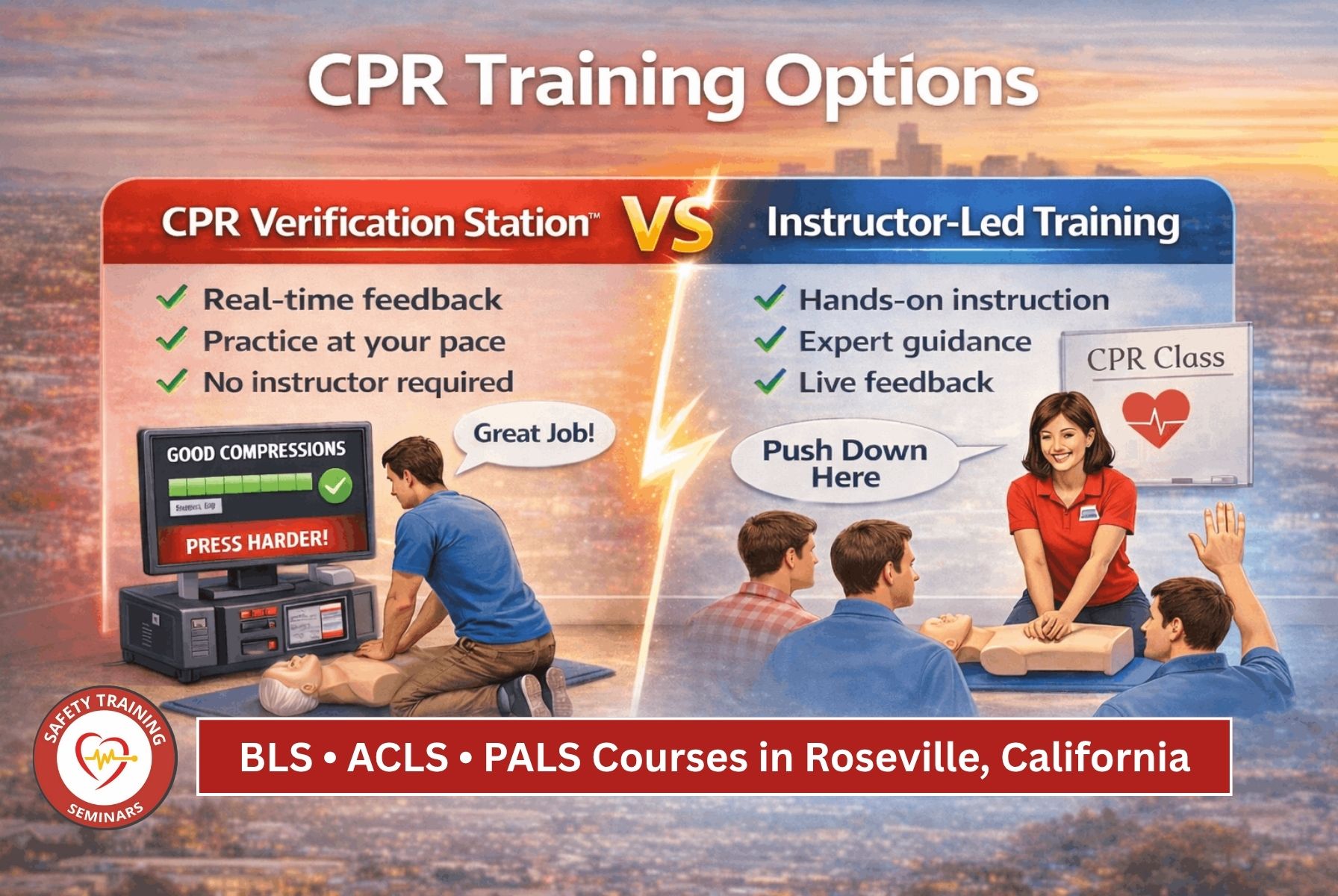
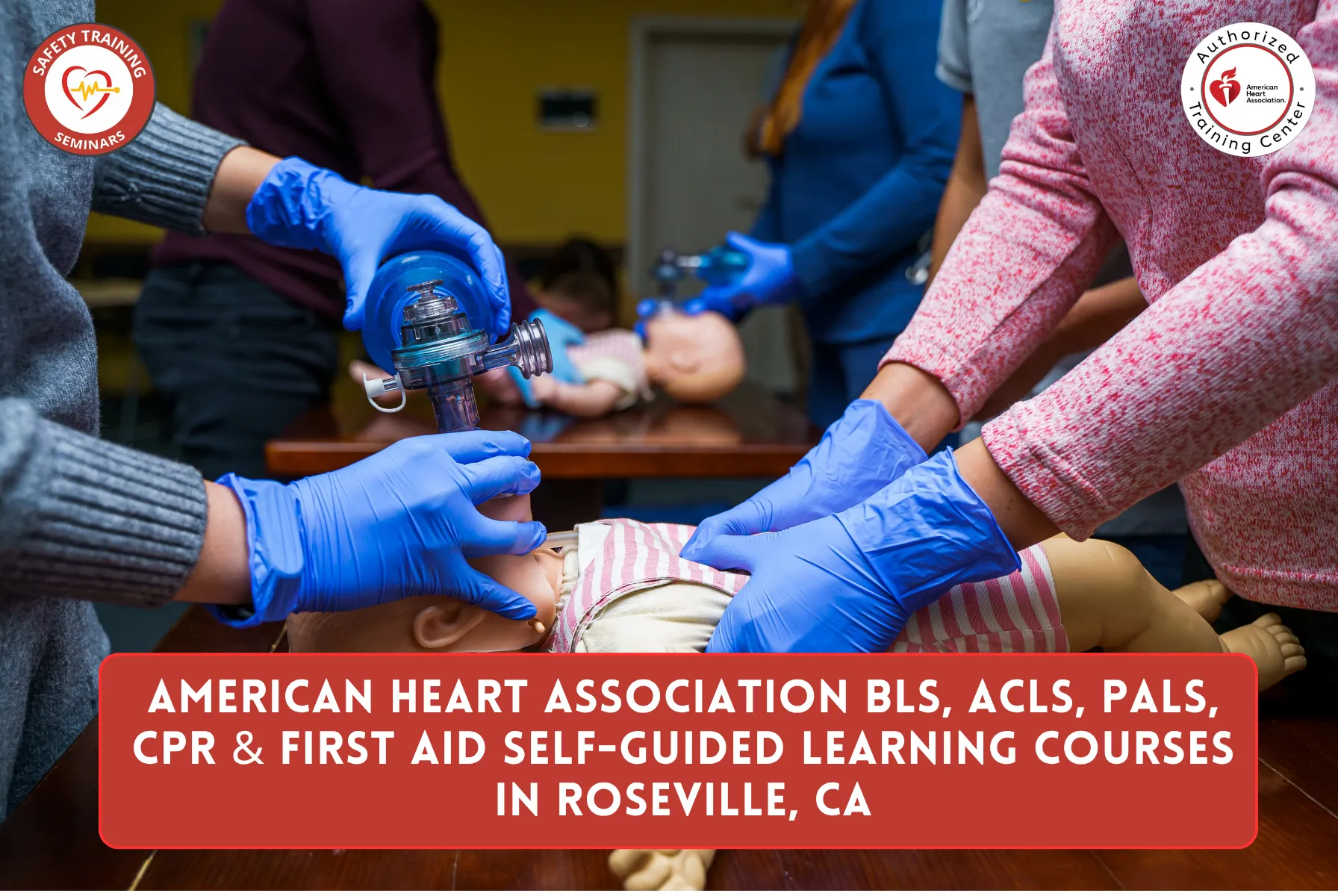
Self-Guided Learning is a flexible delivery method, not a lighter version of a course. The cognitive portion comes first, usually an adaptive online module you complete whenever it suits you. For provider-level courses, a hands-on skills session follows, done in person on feedback-enabled equipment — frequently at an AHA CPR Verification Station learning center. The certification is issued only once the skills portion is finished, the clearest difference between this format and a course that lives entirely online.
Here’s the general flow:
- Choose the course your role or requirement points to.
- Move through the online knowledge module at your own pace.
- Attend the in-person skills session when the course requires one.
- Complete the hands-on skills check for provider courses.
- Receive your course completion card or provider eCard.
Since the process isn’t identical for every course, confirm the details for the one you plan to take.
The Courses You Can Complete This Way
Basic Life Support (BLS)
BLS is the credential most healthcare roles start with, and it’s a frequent request among nursing and allied-health students at programs across the greater Sacramento area, along with working nurses, medical assistants, physicians, EMTs, and dental staff. It reaches past everyday CPR into team-based resuscitation, airway management, and high-quality compressions for all ages. Requirements aren’t uniform from one job to the next, so verify what your program or employer expects. For many local learners, BLS and CPR classes in Roseville are the natural starting point.
CPR, AED, and First Aid
Not every learner works in healthcare. Teachers, coaches, gym and fitness staff, childcare providers, retail and service employees, and parents of young children often take CPR/AED or First Aid to meet a workplace policy or to feel prepared at home. These courses teach compressions, rescue breathing, defibrillator use, and basic injury response, and assume no clinical experience. Because employers accept different versions, ask which course and card yours requires before you enroll.
Advanced Cardiovascular Life Support (ACLS)
ACLS is designed for clinicians who help manage adult cardiovascular emergencies — commonly emergency and critical-care nurses, physicians, paramedics, and similar providers in the area’s growing acute-care settings. It extends BLS with rhythm interpretation, medications, and the team coordination a resuscitation demands. Whether you need it, and how often you renew, depends on your role and workplace, so treat ACLS as specialty-specific rather than blanket.
Pediatric Advanced Life Support (PALS)
PALS concentrates on emergencies involving infants and children and is meant for providers who care for younger patients, such as pediatric and emergency nurses and clinicians in units that treat kids. Like the other provider courses, it pairs independent study with an in-person skills session. If pediatric care is part of your work, confirm whether PALS belongs on your list of requirements.
Choosing the Course That Fits
Enrolling in the wrong class means repeating the process later. This overview shows the typical audience for each:
| Course | Typical audience |
| BLS | Healthcare professionals and clinical students |
| ACLS | Clinicians managing adult cardiac emergencies |
| PALS | Clinicians managing pediatric emergencies |
| CPR/AED | General public and workplace staff |
| First Aid | Schools, childcare, workplaces, community members |
Use it for orientation, not a legal rule. Your requirement can vary with your employer, school, licensing board, or healthcare organization, so confirm the course and accepted format before paying. If you’re uncertain, the office requesting your certification can point you to the right one.
Self-Guided, Classroom, and Online-Only Side by Side
These formats serve different needs:
- Self-Guided Learning blends independent online study with an in-person skills session for provider courses. You manage the pace of the reading while still demonstrating skills in person.
- Traditional classroom training delivers instruction and hands-on work together in one scheduled, instructor-led session, which appeals to people who like a teacher on hand.
- Online-only training takes place fully on a screen. It may work for some awareness-level topics, but it frequently falls short of a requirement that includes a hands-on skills check — a standard feature of provider certifications.
No option is universally superior. The best choice reflects your schedule, learning style, and what your certifying body will accept.
What the Format Offers Roseville Learners
For a suburb where many people commute or juggle irregular hours, the appeal is practical. A nursing student completing clinicals, a hospital employee squeezing a renewal between shifts, a Rocklin or Granite Bay resident who’d rather not drive into Sacramento, or a Lincoln parent working around childcare can all handle the online portion whenever a break appears, then reserve a single visit for the skills session. Renewals go quickly when the material is already familiar. For workplaces keeping a team current, staggering the online work across employees keeps the operation running while everyone stays certified. Providers mapping an advanced path can review the ACLS and PALS course options in Roseville to see what the self-guided route entails.
Safety Training Seminars in Roseville
For learners considering a local option, Safety Training Seminars maintains a Roseville location at 805 Douglas Blvd., Suite 138, Roseville, CA 95678. As you evaluate it, concentrate on the factors that shape your certification: which course you need, whether it covers the hands-on skills your role calls for, and the card or eCard you’ll leave with. Confirm the course format and that the completion documentation will be recognized by your employer or school before registering. Aligning the class with your requirement is the step that saves the most trouble later.
Frequently Asked Questions
Can BLS, ACLS, and PALS all be done through Self-Guided Learning? Yes. AHA Self-Guided Learning is available for all three provider courses. You complete the cognitive coursework on your own, then finish an in-person skills session for the certification. The courses cover different content and audiences, so select the one that matches your clinical role and confirm the specifics before enrolling.
I’m a healthcare student near Roseville — which certification do I need? It depends on your program and clinical placement. Many students need BLS, and those moving into acute-care or pediatric rotations may also need ACLS or PALS. Rather than assume, ask your school or clinical coordinator which certification and card they require, since expectations differ by program and specialty.
Can I finish the online portion before scheduling my skills session? Yes. The standard sequence is to complete the cognitive module first, then attend the in-person skills session. That’s what makes the format manageable for students and shift workers — the reading happens on your own time, and the visit stays focused. Check the exact steps with the provider for your course.
Can someone from a nearby city train at a Roseville center? Yes. Learners from Rocklin, Citrus Heights, Folsom, Granite Bay, Lincoln, and other nearby communities can use a Roseville location, often convenient for people already in the area for work or errands. Confirm course availability and scheduling ahead of time.
Is an online-only certificate accepted for clinical roles? Often not. Many provider positions require a hands-on skills check that a fully online course can’t supply. If your role calls for BLS, ACLS, or PALS, verify whether an online-only certificate is accepted — in most clinical settings, it won’t be sufficient by itself.
Where to Start
Self-Guided Learning keeps the hands-on skills that many certifications require, while an online-only course may not. Before registering anywhere in Roseville, confirm which course your employer, school, or licensing organization requires, then make sure the format you choose includes those in-person skills. Once that’s clear, comparing what Safety Training Seminars offers locally — and matching it to your role and schedule — makes the final call easy.